Will AI Replace Programmers? The Real Answer Nobody Talks About
AI can write code in seconds. But does that mean programmers are becoming unnecessary?
1. Introduction — Start With the Fear
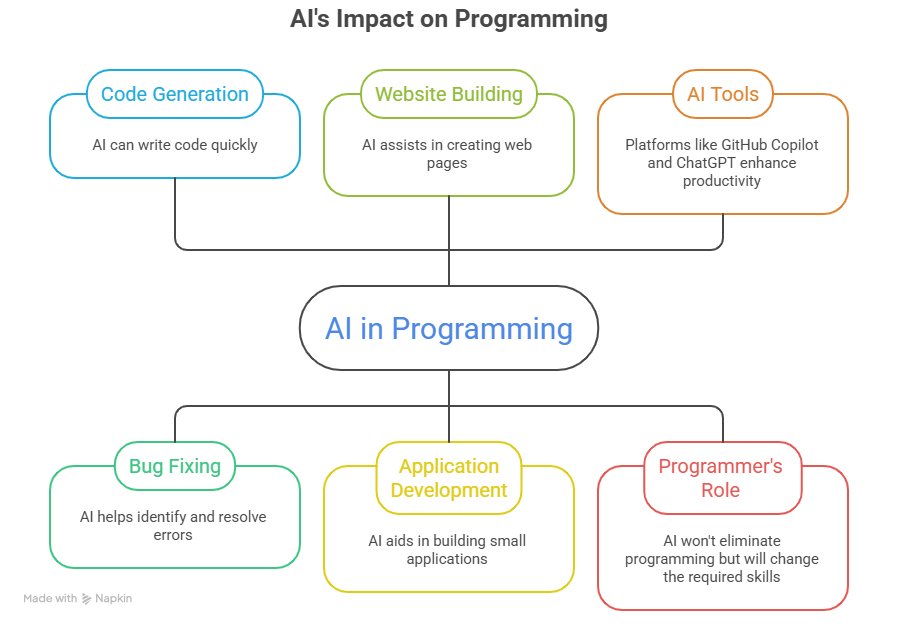
Artificial Intelligence is rapidly changing the way we write software. Today, AI can generate code, find and fix bugs, build websites, and even create small applications with minimal human input. Tools like GitHub Copilot, ChatGPT, Claude, and AI coding agents are becoming increasingly powerful.
This has created a question that many developers and aspiring programmers are asking:
Will AI eventually replace programmers?
The answer, however, is more complicated than a simple “yes” or “no.”
AI probably won't eliminate programming—but it may eliminate the need for programmers who only know how to write code.
2. Why People Think Programmers Will Be Replaced
The fear of AI replacing programmers is not completely unreasonable. AI is already capable of performing many tasks that traditionally required a developer's time and effort.
AI can generate code, debug errors, write tests, create websites and applications, and automate repetitive development tasks. With AI coding agents, developers can even describe a feature in natural language and let the AI handle much of the implementation.
This has significantly changed the development workflow.
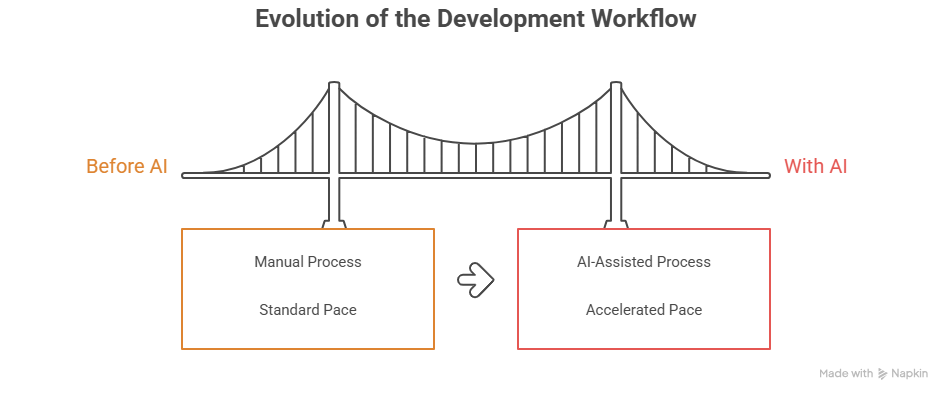
Before AI:
Developer → Understand requirement → Write code → Debug → Test
With AI:
Developer → Describe requirement → AI generates code → Developer reviews → Test → Deploy
The biggest advantage is speed. Tasks that once took hours can sometimes be completed in minutes with AI assistance.
So, a natural question arises:
If AI can do the coding, what is the programmer actually needed for?
And this is where the real discussion about the future of programming begins.
3. What AI Is Actually Good At
AI is extremely powerful when it comes to tasks that are repetitive, predictable, and well-defined. Instead of spending hours writing everything from scratch, developers can use AI to handle many routine parts of software development.
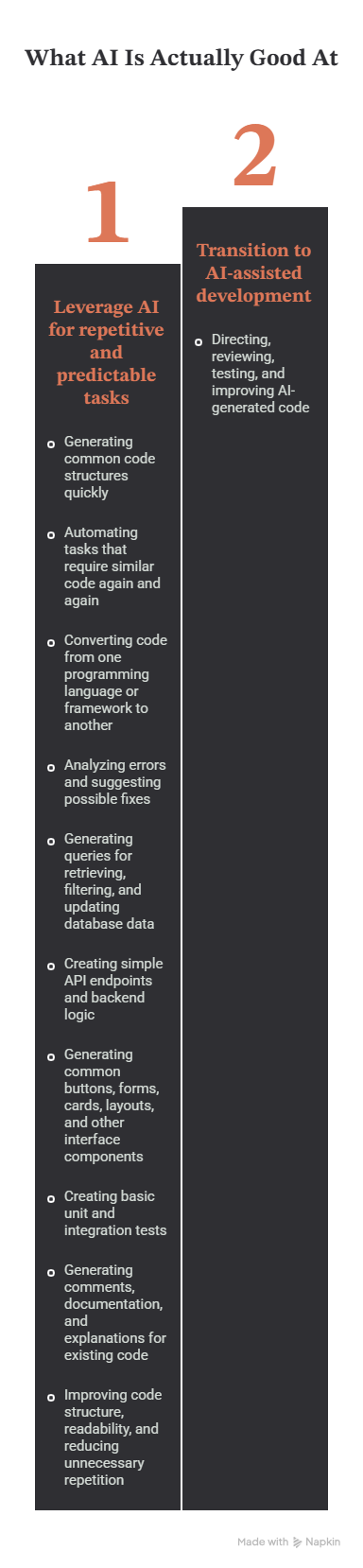
AI is excellent at:
Boilerplate code — Generating common code structures quickly.
Repetitive programming — Automating tasks that require similar code again and again.
Code conversion — Converting code from one programming language or framework to another.
Error explanation — Analyzing errors and suggesting possible fixes.
SQL queries — Generating queries for retrieving, filtering, and updating database data.
Basic APIs — Creating simple API endpoints and backend logic.
UI components — Generating common buttons, forms, cards, layouts, and other interface components.
Testing — Creating basic unit and integration tests.
Documentation — Generating comments, documentation, and explanations for existing code.
Simple refactoring — Improving code structure, readability, and reducing unnecessary repetition.
The important point is that these tasks are increasingly becoming AI-assisted rather than manually performed.
This does not necessarily mean programmers are becoming unnecessary. Instead, it means the programmer's role is gradually shifting from writing every line of code manually to directing, reviewing, testing, and improving AI-generated code.
4. What AI Still Struggles With
AI has become remarkably good at generating code, but writing code is only one part of software engineering. Some of the most important development challenges require context, judgment, experience, and decision-making—areas where AI still has limitations.
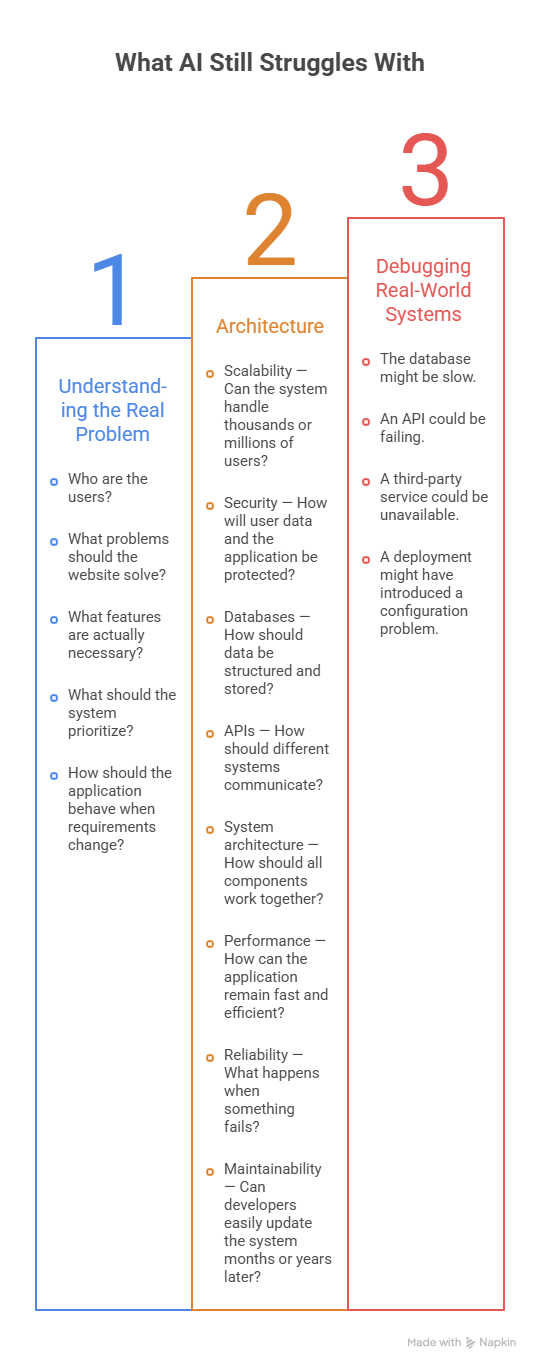
Understanding the Real Problem
Imagine a client says:
“I need a website for my business.”
Creating HTML, CSS, or React components is not the difficult part. The real challenge is understanding what the client actually needs.
A developer needs to ask:
Who are the users?
What problems should the website solve?
What features are actually necessary?
What should the system prioritize?
How should the application behave when requirements change?
AI can suggest solutions, but humans still need to understand the context, communicate with stakeholders, and make the final decisions.
Architecture
Writing a single function is relatively easy. Designing an entire software system is a completely different challenge.
A real application must consider:
Scalability — Can the system handle thousands or millions of users?
Security — How will user data and the application be protected?
Databases — How should data be structured and stored?
APIs — How should different systems communicate?
System architecture — How should all components work together?
Performance — How can the application remain fast and efficient?
Reliability — What happens when something fails?
Maintainability — Can developers easily update the system months or years later?
AI can help with individual decisions, but designing the right architecture requires understanding the entire system and its long-term requirements.
Debugging Real-World Systems
AI can often identify bugs in isolated code. Real-world applications are much more complicated.
A typical production system might look like:
Frontend
   ↓
API
   ↓
Backend
   ↓
Database
   ↓
Third-Party Services
   ↓
Cloud Infrastructure
If something goes wrong, the problem could exist anywhere in this chain.
The database might be slow. An API could be failing. A third-party service could be unavailable. A deployment might have introduced a configuration problem.
Finding the real root cause requires more than generating code—it requires system-level thinking, debugging experience, and engineering judgment.
This is why AI may reduce the amount of code programmers write, but it does not automatically eliminate the need for people who can understand, design, troubleshoot, and take responsibility for complex software systems.
5. The Biggest Change: Programmers vs. AI-Assisted Developers
The future of programming is probably not Human OR AI.
It is much more likely to be:
Human + AI
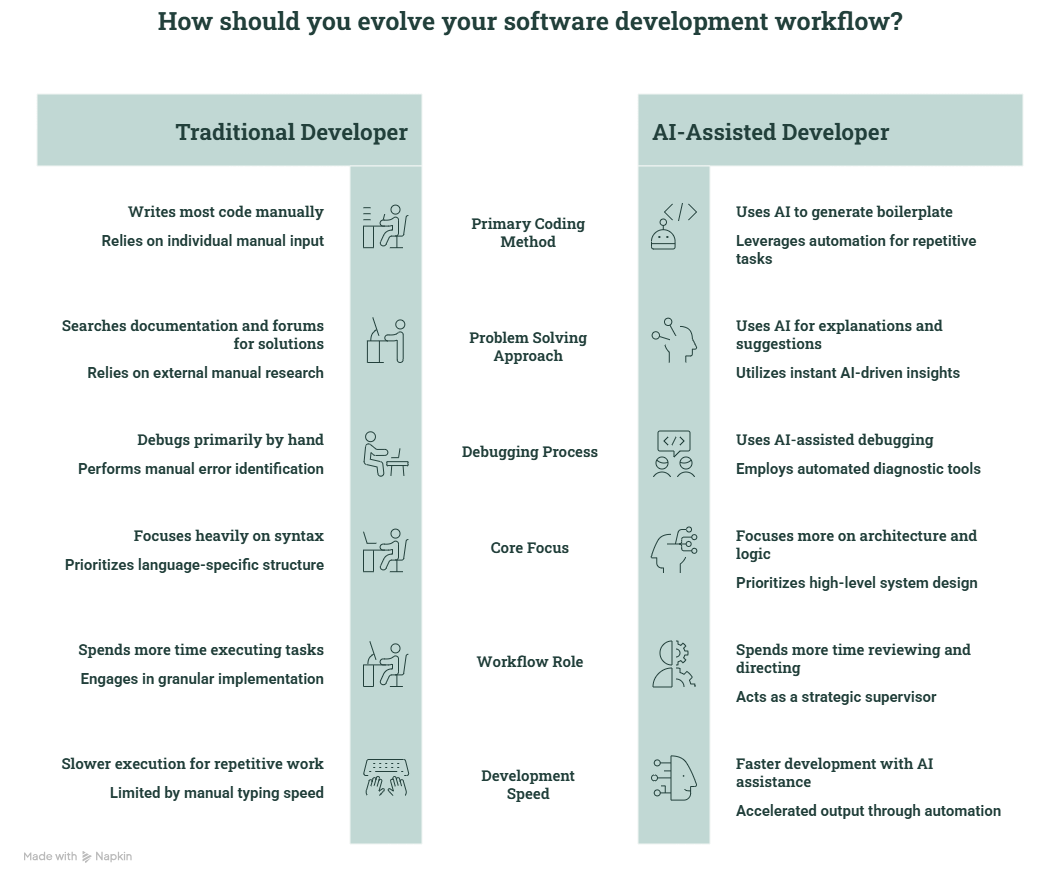
AI is changing how programmers work. Instead of spending most of their time manually writing every line of code, developers can use AI to handle repetitive tasks while they focus on higher-level engineering decisions.
| Traditional Developer | AI-Assisted Developer |
|---|---|
| Writes most code manually | Uses AI to generate boilerplate |
| Searches documentation and forums for solutions | Uses AI for explanations and suggestions |
| Debugs primarily by hand | Uses AI-assisted debugging |
| Builds features step-by-step manually | Gives AI structured instructions |
| Focuses heavily on syntax | Focuses more on architecture and logic |
| Spends more time executing tasks | Spends more time reviewing and directing |
| Slower execution for repetitive work | Faster development with AI assistance |
This does not mean the programmer becomes less important. In many cases, it means the skills that make a good programmer are changing.
The programmer's value is gradually moving from typing code to understanding problems, designing systems, reviewing AI-generated solutions, making technical decisions, and controlling the overall software development process.
In other words, the strongest developer of the future may not be the person who can write the most code manually—but the person who knows what should be built, why it should be built, and how to use AI effectively to build it.
6. Will Junior Developers Be Affected?
This is where the impact of AI could become more complicated.
It would be unrealistic to say that AI will have no effect on junior developers. Many entry-level programming tasks are exactly the kind of work AI can now perform quickly.
For example, junior developers often spend significant time working on:
CRUD APIs
Basic forms
Simple database queries
CSS fixes
Boilerplate components
Basic validation and repetitive code
AI can generate many of these solutions in a matter of seconds.
But this creates a much bigger question:
If AI does the beginner tasks, how will beginners gain real-world experience?
Traditionally, developers learned by starting with simple tasks and gradually moving toward more complex problems. If AI handles many of those basic tasks, companies may expect junior developers to contribute at a higher level much earlier.
That means future developers may need to focus less on simply writing code and more on understanding how software actually works.
Important skills will include:
Programming fundamentals
Debugging and problem-solving
Git and version control
Databases
APIs and backend concepts
Basic system design
Security fundamentals
Software testing
AI-assisted development
AI may therefore make the entry-level path more challenging—but it can also make developers more productive if they learn how to use these tools properly.
The goal for a beginner should not be to compete with AI at writing code.
The goal should be to become the person who understands the code, knows when AI is wrong, and can turn a real-world problem into a reliable software solution.
7. The New Skill: Knowing How to Work With AI
As AI becomes a regular part of software development, programmers will need a new skill: knowing how to work effectively with AI.
AI-assisted programming is not simply about asking an AI to “write my code.” A developer needs to understand the problem, guide the AI, and verify everything it produces.
A modern developer may need to know how to:
Explain requirements clearly so the AI understands what needs to be built.
Provide useful context, including the existing codebase, technologies, constraints, and expected behavior.
Break large problems into smaller tasks that can be solved and verified step-by-step.
Review generated code instead of accepting it blindly.
Detect hallucinations and incorrect assumptions in AI-generated solutions.
Test AI-generated code to make sure it actually works.
Improve the implementation based on performance, security, and maintainability.
Understand the code rather than simply copying and pasting it.
This means AI literacy could become just as important as traditional programming skills.
The future may not belong to programmers who can write the most code. It may belong to programmers who can solve the right problems with the right tools.
8. What Skills Should Programmers Learn Now?
If AI is changing programming, the best response is not to avoid AI. It is to learn how to work alongside it while strengthening the skills AI cannot easily replace.
A future-ready developer should build skills across three areas: technical skills, AI skills, and human skills.
Technical Skills
Strong programming fundamentals are still essential. Developers should understand at least one programming language deeply, rather than relying entirely on AI to write code.
Important areas include:
Programming: Python, JavaScript, Java, or C++
SQL and databases
Git and GitHub
APIs and backend development
Cloud fundamentals
Software testing
Cybersecurity fundamentals
System design and architecture
These skills help developers understand what AI-generated code is doing and determine whether a solution is actually correct.
AI Skills
Developers should also learn how to use AI as a development tool.
Useful AI-related skills include:
Prompt engineering
Using AI coding assistants
AI-assisted code review
AI-assisted debugging
Understanding LLM limitations and hallucinations
Building applications with AI APIs
Working with AI agents and automation
The goal is not simply to become good at prompting. It is to understand when to use AI, how to guide it, and how to verify its output.
Human Skills
Technical knowledge alone will not be enough. Developers also need skills that help them understand problems and make good decisions.
These include:
Problem-solving
Communication
Critical thinking
Product thinking
Understanding users
Decision-making
Ultimately, AI can generate many possible solutions, but someone still needs to decide which problem is worth solving, which solution makes sense, and what trade-offs should be accepted.
The most valuable developers will therefore combine strong technical fundamentals + AI skills + human judgment.
9. The Programmers Most at Risk
The discussion should not simply be about whether AI will replace programmers.
A more accurate statement is:
AI is more likely to replace certain programming tasks than the entire programming profession.
The developers most at risk are those whose work depends heavily on repetitive, predictable tasks without much problem-solving or decision-making.
For example, developers who primarily:
Copy and paste code without understanding it
Memorize syntax instead of understanding concepts
Build repetitive CRUD applications
Blindly trust AI-generated solutions
Avoid learning programming fundamentals
Depend on tools without understanding what happens behind them
may find it increasingly difficult to compete in an AI-assisted development environment.
On the other hand, developers who understand software architecture, systems, users, security, business requirements, and problem-solving can use AI to become significantly more productive.
AI can help them write code faster, explore solutions, automate repetitive work, and reduce development time.
The difference is simple:
Developers who compete with AI may struggle. Developers who know how to use AI can become more capable.
The future of programming may therefore reward adaptability and understanding more than the ability to simply write large amounts of code.
10. The Future of Programming
The future of programming is unlikely to be a world where humans stop writing software entirely. Instead, the development process will continue to evolve as AI becomes a more powerful part of the developer's toolkit.
A typical workflow could look like this:
Human
   ↓
Define the problem
   ↓
Design the solution
   ↓
AI generates implementation
   ↓
Human reviews the code
   ↓
Automated testing
   ↓
Human validates the result
   ↓
Deploy
   ↓
Monitor & improve
In this workflow, AI handles more of the implementation and repetitive work, while humans remain responsible for understanding the problem, making architectural decisions, reviewing results, and taking responsibility for the final product.
The programmer doesn't disappear.
The programmer's role evolves.
Instead of being primarily a person who writes code, the programmer increasingly becomes a problem solver, system designer, AI collaborator, reviewer, and technical decision-maker.
The future developer may write fewer lines of code—but understand and control much more of the software being built.
11. So, Will AI Replace Programmers ?
So, will AI replace programmers?
The most honest answer is:
AI will replace some programming tasks and may eliminate some programming jobs. But it is unlikely to completely replace software engineers in the foreseeable future.
AI is already changing how software is built. Repetitive coding, basic debugging, boilerplate development, and other predictable tasks can increasingly be automated.
But software engineering is much more than writing code. It involves understanding users, defining requirements, designing systems, making technical decisions, managing trade-offs, ensuring security and reliability, and solving problems that do not always have straightforward answers.
The bigger threat, therefore, isn't AI itself.
It's refusing to learn how to work with AI.
Programming is gradually moving from code production toward problem solving, system design, critical thinking, and engineering judgment.
The developers who adapt to this change will not necessarily write the most code. They will be the ones who can understand complex problems, use AI effectively, evaluate its output, and build reliable solutions.
AI may change what it means to be a programmer—but that does not mean programmers are disappearing.
12. Final Section — What Should You Do ?
If you are learning programming today, the answer is not to stop because of AI.
Instead, use AI as a reason to become a better developer.
The goal should not be to compete with AI at writing code line by line. AI will continue to become faster at generating code. Your advantage should come from understanding how software works, why it should be built, and how to make the right technical decisions.
Think of your learning journey like this:
Learn Programming
       +
Understand Computer Science
       +
Learn Software Engineering
       +
Use AI Tools
       +
Build Real Projects
       =
Future-Ready Developer
Start with strong programming fundamentals. Learn how variables, data structures, algorithms, databases, APIs, operating systems, and networks work. Then learn software engineering practices such as Git, testing, security, system design, and deployment.
At the same time, learn how to use AI effectively. Let it help you explore ideas, generate boilerplate, debug problems, write tests, and speed up development—but always understand and verify what it produces.
Most importantly, build real projects. Projects force you to deal with requirements, bugs, unexpected problems, users, databases, deployment, and decisions that tutorials cannot fully teach you.
The future of programming will not simply be about humans versus AI.
It will be about developers who know how to combine human judgment with AI capabilities.
Don't compete with AI at writing code. Learn to become the person who knows what code needs to be written, why it needs to be written, and whether the AI wrote it correctly.
Comments
Join the discussionNo comments yet. Be the first to comment.